 AI agents are starting to pay, book, and act on our behalf. It's time they had IDs.
Asking AI to draft an email, clean up your calendar, or plan a weekend trip barely registers as unusual anymore. At the pace AI agents are moving into everyday life, a scene like this one probably isn't far off.
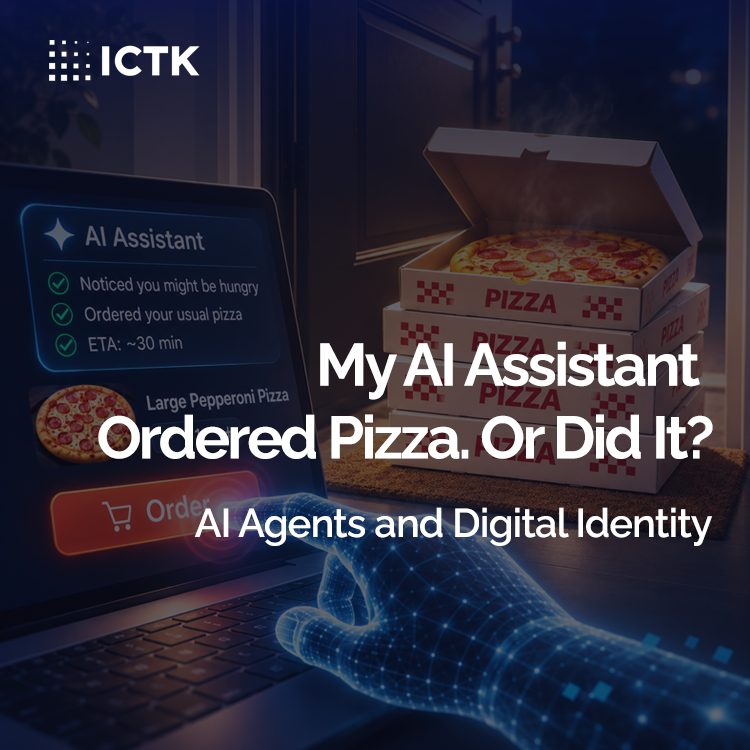
It's Saturday night, and your phone buzzes. "Ordered your usual: large pepperoni. Arriving in about 30 minutes." Your AI assistant noticed you'd be getting hungry right about now and took care of it. It's still hypothetical, but it sounds pretty great.
Now let's twist that scenario. What if the order didn't come from your assistant at all, but from some other program pretending to be it? Over a pizza, you'd probably just laugh it off. But if the same trick were used to book flights, approve a wire transfer from a company account, or send a contract to a client, it's a very different story.
As AI moves from answering questions to taking action, a very old question is back in a new form: "Who are you?"
 Source: Oldboy (2003), dir. Park Chan-wook. (Resketch)
If People Can Be Fooled, What About AI?
That question isn't as far-fetched as it sounds. In early 2024, an employee at the Hong Kong office of global engineering firm Arup joined a video call with what appeared to be the company's CFO and other colleagues. Following their instructions, the employee made 15 transfers totaling HK$200 million, or roughly $25.6 million. The CFO and colleagues on screen were deepfakes. The scam only came to light after the employee checked with Arup's UK head office (Fortune).
The employee saw familiar faces and heard familiar voices, and was still fooled. If people can't reliably verify other people, think about AI agents talking to each other with no faces or voices at all, just data. There are far fewer clues to tell the real one from a fake.
AI Agents Are Already on the Job
"AI handling payments? Isn't that still years away?" Maybe not. Gartner predicts that by 2028, 15% of day-to-day work decisions will be made autonomously by agentic AI, up from 0% in 2024. It also expects 33% of enterprise software applications to include agentic AI by then, up from less than 1% in 2024 (Gartner).
To make decisions and take action, AI agents need access. A scheduling agent gets into your calendar. A purchasing agent uses the corporate card. A customer service agent handles customer data. That's why the security community has started treating AI agents as a new kind of identity. In February 2025, OWASP, the international nonprofit focused on application security, published a dedicated guide to the threats unique to agentic AI and how to mitigate them (OWASP). And in February 2026, the National Cybersecurity Center of Excellence (NCCoE) at the U.S. National Institute of Standards and Technology (NIST) released a concept paper on identity and authorization for AI agents (NIST).
What Does an AI Agent's ID Look Like?
People carry a driver's license. At work, you tap an ID badge to get through the door. AI agents have something similar: credentials such as API keys, access tokens, and digital certificates. When an agent connects to a payment service or an internal system, it presents those credentials, and the system checks them and lets it in: "Got it, you're the agent we registered."
The NIST concept paper centers on four areas for AI agents: identification, authorization, auditing, and non-repudiation. In plain terms, an agent's ID needs to answer three questions.
1. Who are you? (Identification)
Is the agent making this request really the one I registered? With an ID badge, this is checking that the photo and name match the person.
2. What are you allowed to do? (Authorization)
Even with a valid identity, an agent shouldn't be able to do everything. A pizza-ordering agent has no business approving company wire transfers. Your badge gets you into the building, but not into the server room unless you're on the list. This is where the principle of least privilege comes in: grant only the access that's actually needed.
3. Can you prove what you did? (Auditing and non-repudiation)
When something goes wrong, you need to trace who placed that order, when, and with what authority. And the record has to hold up, so the agent can't later claim, "That wasn't me." Think of the access log your badge leaves every time you tap in.
The Real Question: Where Do You Keep the ID?
At this point, it might sound like the answer is simply to issue good credentials. There's a catch, though. Credentials in software are ultimately just data, and data can be copied.
Picture this: your ID badge is just a photo on your phone, and the door opens for anyone who shows that photo. The moment someone quietly copies it, two people are walking around with your badge. That's essentially what can happen when an API key or token stored on a server or in a config file leaks. Without additional checks, an attacker doesn't need to take over the agent itself. The stolen credential alone is enough to pose as it.
That's why the security industry has long kept the most critical part of an identity, the private key that proves it, in dedicated hardware out of reach of ordinary software. The secure hardware in your phone, the TPM in your PC, HSMs in banks and data centers, and the secure chips built into all kinds of devices do exactly this. They're designed to use the private key internally and never let it out, so even if stored files leak, copying the key itself becomes much harder.
More recently, some technologies go a step further and derive a unique identity from the physical properties of the chip itself. Even chips from the same production run end up with tiny physical differences. Those differences arise randomly during manufacturing, so not even the manufacturer can produce an identical copy of a chip. Think of it as a chip's fingerprint. Instead of storing a key in memory, this approach regenerates it from the chip's physical characteristics when needed, which can bind the identity of the devices and servers that AI agents run on much more tightly.
Hardware alone doesn't solve everything, of course. It has to work alongside fine-grained permissions, monitoring that flags unusual behavior, and human sign-off on critical actions. Hardware is best thought of as the starting point that every other check relies on.
Will These IDs Hold Up in the Quantum Era?
There's one more thing to consider. Many of the signature schemes behind today's digital IDs rely on public-key cryptography such as RSA and ECC, which a sufficiently powerful quantum computer is expected to be able to break. That's why NIST finalized its first post-quantum cryptography standards in 2024 (NIST). If AI agents are going to run on infrastructure meant to last years or even decades, their IDs need to last just as long. That's why the move to post-quantum cryptography (PQC), designed to resist even quantum attacks, is part of the conversation.
Back to That Saturday Night Pizza
A world where your AI assistant orders pizza for you sounds like fun. For it to stay fun, you need to be confident the order really came from your assistant. Just as people have always needed ID, AI agents that make their own decisions and take action need ID too. And that ID has to answer three questions: who it is, what it's allowed to do, and what it actually did.
In the end, it comes down to where trust starts. An ID kept somewhere it can be copied will eventually be copied. The more work we hand off to AI, the more it matters to keep that ID somewhere it can't easily be duplicated.
References
- Fortune, coverage of the deepfake video-call fraud at Arup's Hong Kong office (May 17, 2024): fortune.com
- Gartner, "Gartner Predicts Over 40% of Agentic AI Projects Will Be Canceled by End of 2027" (June 25, 2025): gartner.com
- OWASP GenAI Security Project, "Agentic AI – Threats and Mitigations" (February 17, 2025): genai.owasp.org
- NIST NCCoE, "Accelerating the Adoption of Software and AI Agent Identity and Authorization" concept paper (February 5, 2026): nist.gov
- NIST, "NIST Releases First 3 Finalized Post-Quantum Encryption Standards" (August 13, 2024): nist.gov
See It in Action
Curious how to protect the identity of AI agents and the devices they run on, starting at the hardware level? Explore ICTK's hardware security technology.
☑️ Explore ICTK Hardware Security Solutions
☑️ Contact Our Team








AI agents are starting to pay, book, and act on our behalf. It's time they had IDs.
Asking AI to draft an email, clean up your calendar, or plan a weekend trip barely registers as unusual anymore. At the pace AI agents are moving into everyday life, a scene like this one probably isn't far off.
It's Saturday night, and your phone buzzes. "Ordered your usual: large pepperoni. Arriving in about 30 minutes." Your AI assistant noticed you'd be getting hungry right about now and took care of it. It's still hypothetical, but it sounds pretty great.
Now let's twist that scenario. What if the order didn't come from your assistant at all, but from some other program pretending to be it? Over a pizza, you'd probably just laugh it off. But if the same trick were used to book flights, approve a wire transfer from a company account, or send a contract to a client, it's a very different story.
As AI moves from answering questions to taking action, a very old question is back in a new form: "Who are you?"
If People Can Be Fooled, What About AI?
That question isn't as far-fetched as it sounds. In early 2024, an employee at the Hong Kong office of global engineering firm Arup joined a video call with what appeared to be the company's CFO and other colleagues. Following their instructions, the employee made 15 transfers totaling HK$200 million, or roughly $25.6 million. The CFO and colleagues on screen were deepfakes. The scam only came to light after the employee checked with Arup's UK head office (Fortune).
The employee saw familiar faces and heard familiar voices, and was still fooled. If people can't reliably verify other people, think about AI agents talking to each other with no faces or voices at all, just data. There are far fewer clues to tell the real one from a fake.
AI Agents Are Already on the Job
"AI handling payments? Isn't that still years away?" Maybe not. Gartner predicts that by 2028, 15% of day-to-day work decisions will be made autonomously by agentic AI, up from 0% in 2024. It also expects 33% of enterprise software applications to include agentic AI by then, up from less than 1% in 2024 (Gartner).
To make decisions and take action, AI agents need access. A scheduling agent gets into your calendar. A purchasing agent uses the corporate card. A customer service agent handles customer data. That's why the security community has started treating AI agents as a new kind of identity. In February 2025, OWASP, the international nonprofit focused on application security, published a dedicated guide to the threats unique to agentic AI and how to mitigate them (OWASP). And in February 2026, the National Cybersecurity Center of Excellence (NCCoE) at the U.S. National Institute of Standards and Technology (NIST) released a concept paper on identity and authorization for AI agents (NIST).
What Does an AI Agent's ID Look Like?
People carry a driver's license. At work, you tap an ID badge to get through the door. AI agents have something similar: credentials such as API keys, access tokens, and digital certificates. When an agent connects to a payment service or an internal system, it presents those credentials, and the system checks them and lets it in: "Got it, you're the agent we registered."
The NIST concept paper centers on four areas for AI agents: identification, authorization, auditing, and non-repudiation. In plain terms, an agent's ID needs to answer three questions.
1. Who are you? (Identification)
Is the agent making this request really the one I registered? With an ID badge, this is checking that the photo and name match the person.
2. What are you allowed to do? (Authorization)
Even with a valid identity, an agent shouldn't be able to do everything. A pizza-ordering agent has no business approving company wire transfers. Your badge gets you into the building, but not into the server room unless you're on the list. This is where the principle of least privilege comes in: grant only the access that's actually needed.
3. Can you prove what you did? (Auditing and non-repudiation)
When something goes wrong, you need to trace who placed that order, when, and with what authority. And the record has to hold up, so the agent can't later claim, "That wasn't me." Think of the access log your badge leaves every time you tap in.
The Real Question: Where Do You Keep the ID?
At this point, it might sound like the answer is simply to issue good credentials. There's a catch, though. Credentials in software are ultimately just data, and data can be copied.
Picture this: your ID badge is just a photo on your phone, and the door opens for anyone who shows that photo. The moment someone quietly copies it, two people are walking around with your badge. That's essentially what can happen when an API key or token stored on a server or in a config file leaks. Without additional checks, an attacker doesn't need to take over the agent itself. The stolen credential alone is enough to pose as it.
That's why the security industry has long kept the most critical part of an identity, the private key that proves it, in dedicated hardware out of reach of ordinary software. The secure hardware in your phone, the TPM in your PC, HSMs in banks and data centers, and the secure chips built into all kinds of devices do exactly this. They're designed to use the private key internally and never let it out, so even if stored files leak, copying the key itself becomes much harder.
More recently, some technologies go a step further and derive a unique identity from the physical properties of the chip itself. Even chips from the same production run end up with tiny physical differences. Those differences arise randomly during manufacturing, so not even the manufacturer can produce an identical copy of a chip. Think of it as a chip's fingerprint. Instead of storing a key in memory, this approach regenerates it from the chip's physical characteristics when needed, which can bind the identity of the devices and servers that AI agents run on much more tightly.
Hardware alone doesn't solve everything, of course. It has to work alongside fine-grained permissions, monitoring that flags unusual behavior, and human sign-off on critical actions. Hardware is best thought of as the starting point that every other check relies on.
Will These IDs Hold Up in the Quantum Era?
There's one more thing to consider. Many of the signature schemes behind today's digital IDs rely on public-key cryptography such as RSA and ECC, which a sufficiently powerful quantum computer is expected to be able to break. That's why NIST finalized its first post-quantum cryptography standards in 2024 (NIST). If AI agents are going to run on infrastructure meant to last years or even decades, their IDs need to last just as long. That's why the move to post-quantum cryptography (PQC), designed to resist even quantum attacks, is part of the conversation.
Back to That Saturday Night Pizza
A world where your AI assistant orders pizza for you sounds like fun. For it to stay fun, you need to be confident the order really came from your assistant. Just as people have always needed ID, AI agents that make their own decisions and take action need ID too. And that ID has to answer three questions: who it is, what it's allowed to do, and what it actually did.
In the end, it comes down to where trust starts. An ID kept somewhere it can be copied will eventually be copied. The more work we hand off to AI, the more it matters to keep that ID somewhere it can't easily be duplicated.
References
See It in Action
Curious how to protect the identity of AI agents and the devices they run on, starting at the hardware level? Explore ICTK's hardware security technology.
☑️ Explore ICTK Hardware Security Solutions
☑️ Contact Our Team